In Pakistani house construction, plumbing has two moments that matter. The first is the rough-in: when pipes are laid inside walls and floors before plaster and tiles. The second is ten years later, when a leak or blocked drain appears and someone has to break your new tiles to find it.
Almost every expensive plumbing problem we have repaired in newer homes traces back to a shortcut taken at the rough-in stage. This guide explains what rough-in plumbing involves, which materials are used in Pakistan, and a checklist to follow before the walls are closed, so you get it right the first time.
Quick Answer
Rough-in plumbing is laying all the hidden pipes (water supply, drainage and vents) before plaster, tiles and fixtures go in. In Pakistan this usually means PPR pipes for water supply and UPVC/PVC pipes for drainage. The three things that matter most: correct drain slope, a proper pressure test before plastering, and photos of every wall before it’s closed.
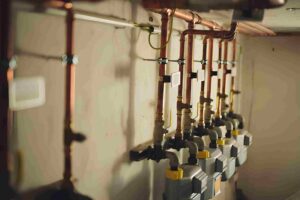
The Three Parts of Rough-In
1. Water Supply Lines
Pipes that bring water from the overhead tank (and the main line) to every tap, shower, commode and geyser. In new Pakistani houses, these are almost always PPR pipes joined by heat fusion. Hot and cold lines are run separately; hot lines go to the geyser outlet.
2. Drainage (Waste and Soil Lines)
Pipes that take dirty water away: from sinks, showers and floor drains (waste), and from commodes (soil). These are UPVC/PVC pipes, typically 4 inch for commode lines and 2 to 3 inch for sinks and floor drains, leading to the gully trap and sewer line.
3. Vents
A vent pipe lets air into the drainage system so water flows smoothly and traps don’t get sucked dry. Many Pakistani houses skip it, which is why bathrooms gurgle and smell. Read more in our plumbing vent pipe guide.
Common Materials in Pakistan
| Material | Used For | Notes |
|---|---|---|
| PPR (polypropylene) | Hot and cold water supply | Standard in new houses; heat-fused joints; doesn’t rust |
| UPVC / PVC | Drainage and vents | Use proper pressure-class pipe, not the thinnest grade |
| GI (galvanized iron) | Old houses | Rusts inside over time; usually replaced during renovation |
| Flexible connectors | Final fixture connections | Part of finishing, not rough-in |
Buy from a known brand and check that fittings match the pipe brand; mixing brands is a common cause of weak joints.
Before-Plaster Checklist
- Choose your fixtures first. Commode type (floor outlet or wall outlet), mixer style and geyser position decide where pipes must end. Changing them after tiling is costly.
- Mark hot and cold. Standard practice is hot on the left, cold on the right. Mismatched mixers are a daily irritation for years.
- Check drain slope. Horizontal drain pipes need a steady fall, roughly 1 to 2 cm per metre. Too flat and waste settles; never let a pipe run uphill.
- Use bends, not sharp elbows, on drainage lines where possible; sharp 90° turns are where blockages start.
- Add cleaning access points on long drain runs so they can be cleared without breaking anything.
- Plan the main line size. The line from the overhead tank should be big enough (at least 3/4 inch for the main) to keep pressure up on all floors. See our low water pressure guide.
- Put a stop valve on each bathroom and kitchen, so one leak doesn’t mean shutting the whole house.
- Pressure test the supply lines before any plaster: fill and pressurise the system, close it, and watch a pressure gauge for several hours (ideally overnight). Any drop means a leak somewhere.
- Test drains with water: pour water down every floor drain and pipe end and check it flows freely to the gully trap.
- Photograph every wall and floor with a tape measure in the shot. Years later, these photos tell you exactly where a pipe is before you drill or break anything.
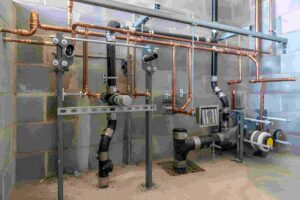
10 Expensive Rough-In Mistakes
- Skipping the pressure test to “save a day”
- Drain pipes laid flat or with dips
- No vent, leading to gurgling drains and sewer smell
- Commode outlet position not matched to the commode being bought
- Hot and cold swapped at the mixer
- Cheap, thin drainage pipes that crack under the floor
- Water pipes running through the floor where they’ll be hit by tile fixing or heavy loads
- No stop valves for individual bathrooms
- Pipes too close to electrical conduits
- No photos, so future repairs mean guessing and breaking
How Plumbers Usually Quote
In Pakistan, labour for new house plumbing is usually quoted per point (each tap, shower, commode or drain counts as a point) or per bathroom/kitchen, with material bought separately by the owner or included in a package. When comparing quotes, ask:
- Is the pressure test included?
- Which brand of PPR and UPVC is assumed?
- Are vents and cleaning access points included?
- Who fixes leaks found after tiling, and for how long?
For typical repair rates once the house is in use, see our plumber rates guide.
Frequently Asked Questions
Rough-in plumbing kya hoti hai?
Ghar ki tameer mein plaster aur tiles se pehle deewaron aur farsh ke andar paani, drainage aur vent ki pipes bichhana. Yeh woh hissa hai jo baad mein nazar nahi aata lekin sab se zyada ahem hai.
Naye ghar mein kaunsi pipe behtar hai?
Paani ke liye PPR pipe (garam aur thanda dono), aur drainage ke liye achhi quality ki UPVC/PVC pipe. Purani GI pipes ab nahi lagani chahiye.
Plaster se pehle pressure test kyun zaroori hai?
Kyunke plaster aur tiles ke baad leak dhoondna aur theek karna bohot mehnga parta hai. Test se kamzor joint pehle hi pakra jata hai.
Drain pipe ka slope kitna hona chahiye?
Taqreeban 1 se 2 cm har meter par, aur pipe kahin bhi upar ki taraf nahi jani chahiye.